

The 54 Gene Story: Lessons For Healthcare Entrepreneurs And Leaders In Africa
Published on: November 8, 2023

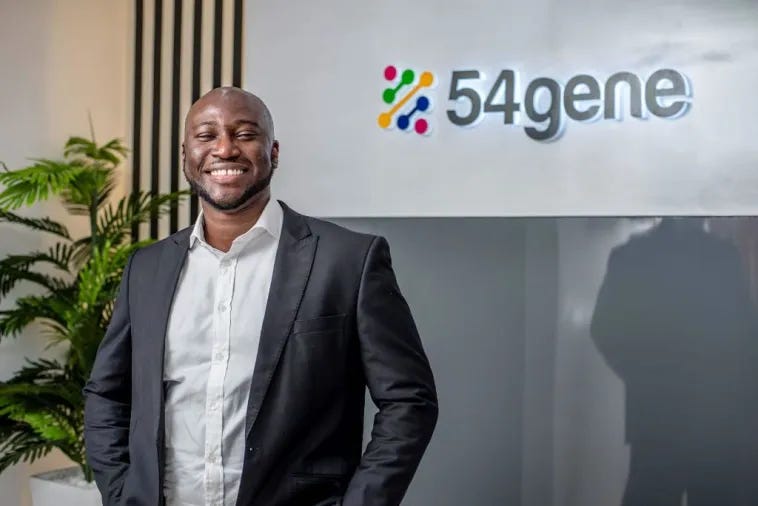
From the dramatic resignation of its co-founder and CEO to multiple rounds of layoffs that took the staff strength from 300 to 39 in just two months, the African biotech pioneer was already slowly showing perceivable signs of a company in distress.
Despite raising funds in three healthy funding rounds, in July of 2023, 54gene, a leading biotechnology startup co-founded in September 2019 by Dr Abasi Ene-Obong to fill the gap in the global gene market for Africans, announced that it was shutting down and listing its assets for sale.
54gene was founded by Dr Abasi Ene-Obong, who left his role as a management consultant in the pharmaceutical sector in the US to return to Nigeria and build Africa’s first biobank.
54gene, until its shutdown, operated Africa’s first private lab for human genome sequencing.
The company was on its way to making glorious history and cementing its achievements in the sands of technological times in Africa—a promise it wouldn’t fulfil.
Before folding up, 54gene aimed to enhance drug discovery on the African continent by providing rare genomics data specific to Africa for international pharmaceutical and research firms.
54gene aspired to bridge a significant gap in the global genomic market, which has less than 3% of genomic material for pharmaceutical research sourced from Africa. Positioned to be a titan in its industry, with no significant competition, a smart workforce, sufficient cash, experienced senior executives, and state-of-the-art, rare equipment, the startup was on its way to becoming an enviable monument to biotechnological wonder in Africa.
However, in under four years, this promising startup began to suffer. The founding CEO was replaced, and in the last year alone, the company has seen three CEO changes.
What happened to 54gene?
Well, reports and investigations point to many internal factors that contributed to its failure, and one that stands out is how the company managed its finances, coupled with poor decision-making.
In this article, we will examine the lessons healthcare entrepreneurs and leaders can draw from the 54gene saga.
There was significant controversy surrounding 54gene’s shutdown; however, this piece isn’t an investigative piece.
We just want to highlight valuable lessons for healthcare entrepreneurs and leaders interested in venturing into novel areas of digital health and healthcare entrepreneurship on the African continent.
The 54gene Dream

Africans have the most genetically diverse DNA in the world but make up only 2-3% of the world’s genetic database
In research, especially medical and pharmaceutical research, there’s a need for researchers to have actual biological data they can use to work, and the nature of the data they have goes a long way toward determining the characteristics (and effectiveness) of the medical and pharmaceutical products designed/developed.
In the global genetic ecosystem, Africans are poorly represented, with less than 3% of genomic data belonging to Africans, and this lack of diversity is a significant and real problem facing the global biotechnology industry.
Medical and pharmaceutical solutions must be universal in their design and development; that is, the data used to develop these solutions must be comprehensive enough to represent everyone in the population that will eventually use them. If there’s any form of bias in data representation, how effective do we think these solutions would be in the long run?
Also, certain medical and pharmaceutical products, solutions and interventions should be custom-made for Africans. How do we design tailored medical and pharmaceutical solutions for Africans when we don’t have enough quality data to work with?
“We see ourselves as a health technology company deriving insights from the world’s most diverse populations to solve some of healthcare’s biggest challenges.” – Delali Attipoe (Chief Operating Officer, 54gene).
54gene came on board to address this issue by building a genetic database for Africa.
This idea, this beautiful novel idea, attracted enough financial backing from world-class investors such as Y Combinator, Hack VC, Techammer, Endeavour Catalyst, and KdT Ventures, among others.
Table of Contents
The Pandemic High

The pandemic took many businesses to their early graves.
However, while businesses were dying and some were going bankrupt, some companies were making a lot of money, like the vaccine makers and the COVID testers.
54gene flourished during the pandemic.
It already had the resources and expertise needed to test for the virus, so it leveraged that strength and generated substantial revenue.
Though it slightly deviated from its original purpose as a clinical research company. 54gene was somewhat carried away with this newfound money-making channel, which also helped it cushion the effect of the money it was spending on genomic research, which already is a costly venture to run, especially in Africa where electricity is a big issue for companies like 54gene that rely heavily on power supply to preserve samples and store terabytes of data.
COVID did come to an end, and almost immediately, that source of cash dried up!
The end of the pandemic killed a lot of businesses that relied on it for their survival (ironically, its beginning also killed a lot of businesses).
There were a lot of health tech startups that relied on the lockdowns and COVID testing to survive.
Immediately after the pandemic ended and lockdowns were lifted, many of those startups began to struggle.
A couple of them either went bankrupt or quickly adapted and ventured into other things, while a large number of them just shut down and disappeared from the radar.
7 River Labs (7RL)

7RL was a darling of 54gene, created to fill the “money gap” left by the COVID-19 testing boom for the company.
Was it a success? It wasn’t.
Experts have reported that the 7RL idea may have marked the beginning of 54gene’s downfall.
During its eight months of operation, 7RL sucked out the most money from the blood vessels of a company that was still in its infancy stage.
Why wasn’t it a success? 54gene had all the resources needed to run 7RL! From reports and investigations, there was more to it than meets the eye.
An ongoing “running out of money” outbreak currently plagues African startups. And 54gene couldn’t adequately defend itself against infection.
Careless handling of funds, inadequate research and making hasty decisions without adequate planning and strategy were part of the reasons why 7RL died early.
Managing Finance Is Considered One Of The Biggest Challenges Of Running A Startup

In the startup universe, money can be a hero or a villain.
It depends on your relationship with it.
When success begins to knock at the door and money begins to flow through starting companies, this is the period when the integrity of the leaders is tested.
And unfortunately, in Africa, history has revealed that most startup leaders have a very poor relationship with money.
They tend to be so carried away with all the hype of the initial success that they forget how long the road is and the need to stay focused and disciplined.
According to numerous reports and investigations, 54gene definitely had a financial issue. Insiders and people who followed the company closely reported that it spent money irresponsibly without conducting thorough research.
The team at 54gene were venturing into an entirely new market. They didn’t have any blueprints or case studies to follow. Nobody had done what they were doing in Africa before.
That is all the more reason they had to be extra careful.
But it looked as if they threw caution to the wind and felt that they had all the money in the world.
Little did they know that a period of financial famine would set in, and investors wouldn’t be willing to splurge more cash to keep the young company afloat.
54gene made history as the only health-tech startup in Nigeria to secure the biggest seed round from its beginning in 2019, which was $4.5mn from Y Combinator, Fifty Years, Better Ventures and KdT Ventures.
The financial issue in the startup ecosystem, especially in Africa, is not entirely a matter of a lack of financial management competence but of a lack of discipline among top leaders who are in it for the money rather than problem-solving.
Most young entrepreneurs and leaders need to recalibrate their mindset to understand that entrepreneurship and startup business are a marathon, not a sprint.
Satisfaction shouldn’t come from the money you are making. Instead, it should come from the problem you are solving and the people you are helping as an entrepreneur.
Do Your Research
When 54gene launched Seven Rivers Lab after the COVID-19 pandemic, they did so with so much abandon.
They didn’t thoroughly consider the terrain they were venturing into.
One would expect that a global company like 54gene shouldn’t joke with its research before venturing into new markets. However, they fell for the trap of being too excited about the potential in a new market.
54gene made about $ 20 million from the COVID-19 pandemic, and immediately after the pandemic was over, that stream dried up.
They felt that they could quickly switch to diagnostics since they had solid experience and success with the pandemic.
Their plan failed badly, as Seven River Labs didn’t even last up to a year.
It came crashing down within eight months of operation.
Entrepreneurs must learn to do their research before embarking on new projects.
Don’t allow excitement to cloud your judgment. It’s natural to be excited about new possibilities; however, you must be able to control your excitement and ensure you do the right thing.
54gene should have been more thorough with their research before they started 7RL. If they had done enough research, they wouldn’t have bothered to spend so much resources on 7RL. Instead, they would have used their resources to keep building their original idea.
Always Stay On Course
It’s easy to get carried away by shiny things in the startup ecosystem. It happens to all of us. It’s the few who are disciplined enough to stay true to their calling and mission who become successful.
54gene got carried away with shiny things. And their woes started with trying to immediately create another subsidiary after the pandemic, without enough research and planning.
The company was just four years old, still trying to solidify its presence in a new market on a continent plagued with enough challenges to strangle any startup. Yet, they went ahead and took upon themselves a burden too heavy for them.
I believe that if 54gene hadn’t bothered themselves with investing blindly in a venture like Seven River Labs (7RL) immediately after the pandemic, maybe they would have had enough financial blood to survive the shock. Just maybe.
However, coupled with the Seven Rivers Labs palaver and other internal issues, such as the poor handling of company funds and strained relationships among top leaders, the budding company stood no chance.
Strategic Planning
Strategic planning simply means developing tactics for tomorrow while considering today and studying your past.
You study where you are coming from, where you are at the moment, and the possible future to design and implement your plans. In strategic planning, you are never in a hurry and always ready to adapt if your plans don’t work.
Entrepreneurs can’t afford to use strategic planning principles to “failure proof” their businesses and ideas.
No one is entirely sure about how their business might perform in the future. However, with strategic planning, entrepreneurs can position their companies for success, thereby increasing their chances of survival.
Responsible Leadership
Responsible leaders understand the delicate aspect of leadership responsibility. You have to be ready to be responsible in the world of entrepreneurial leadership.
Most of the young leaders in African tech startups need to fully understand the importance of responsibility. If you don’t want to be responsible, then you have no business in the startup world.
It takes responsible leaders to do quality work in the startup world because they are open to learning, ready to give their all and not bothered about cash.
Transparent Communication
Lack of communication is one weakness that can cripple whole organisations.
You have to be ready to tell the people around you the truth and also be able to effectively communicate organisational goals, wins, and struggles.
If you want to have a solid organisational structure, you must be ready to take communication seriously.
Consequences?
Experts believe 54gene’s failure will have dire consequences for the health technology industry in the whole of Africa.
54gene was the biggest player in its field on the African continent.
It pulled in plenty of funds and resources, but at the end of the day, it all came crashing down like a pack of cards.
This incident might prompt investors to think more deeply and even hesitate to fund startups of this kind in Africa.
We are still very optimistic and believe lessons have been learnt.
The 54gene story might look like a failure. However, there are many lessons to be learnt, and this article has tried to highlight a few of them.
Did 54gene Really Fail?
Despite stopping halfway towards its goals as a company, 54gene still recorded significant success in biotech in Africa.
They have shown the world that it’s possible to build a biobank for Africa, and they have also, in some way, created a path for others to follow.
Future African biotech startups now have a solid case study to follow closely. A privilege 54gene didn’t have when it started.
The story of 54gene has enough lessons for upcoming biotech and health-tech startups in Africa.
Abasi Ene-Obong Has Moved On

True entrepreneurs and leaders are constantly active. They are always looking for ideas to build and visions to push forward.
After leaving 54gene, a company he said he loved so much, Abasi Ene-Obong brought his experience and expertise to work creating Syndicate Bio, a project identical to 54gene.
Here’s a LinkedIn post he wrote announcing Syndicate Bio:
“After a few months in stealth mode, I am happy to say that we have started Syndicate Bio to empower inclusive advancements in global genomics science.”
Syndicate Bio looks like a quieter project, lacking all the pomp and hype of an African biotech startup. Nevertheless, I believe it’s an endeavour that looks promising and might succeed, considering its founder’s passion, experience and expertise.
Not much is known about Syndicate Bio, but their website is a great resource for learning more about the company.
Conclusion
We may not deeply know all that transpired within the walls of 54gene that led to the company’s crash.
There are still a lot of wild and unfounded claims running all over the place.
However, we are more concerned with the lessons.
The entrepreneur’s journey is smoother when they know how to learn from others’ mistakes.
54gene’s journey offers many lessons for African entrepreneurs.
It shows us that entrepreneurial success is a combination of many things.
There’s a role your technical skills play; there’s also room for your education prowess to shine, and critical is your attitude towards money and how you interact with people.

Daniel Ayinla
Chief Editor
Related Posts

We Are Extending Applications For The Healthcare To Healthtech Bootcamp
Digital Health
Read Now
The Multifaceted Role Of Mobile Health Applications In Improving Access To Healthcare In Africa
Digital Health
Read Now
Harnessing The Power Of Artificial Intelligence In Africa’s Healthcare Ecosystem: The Possibilities And Sharing Ideas
Healthcare Innovation
Read Now